
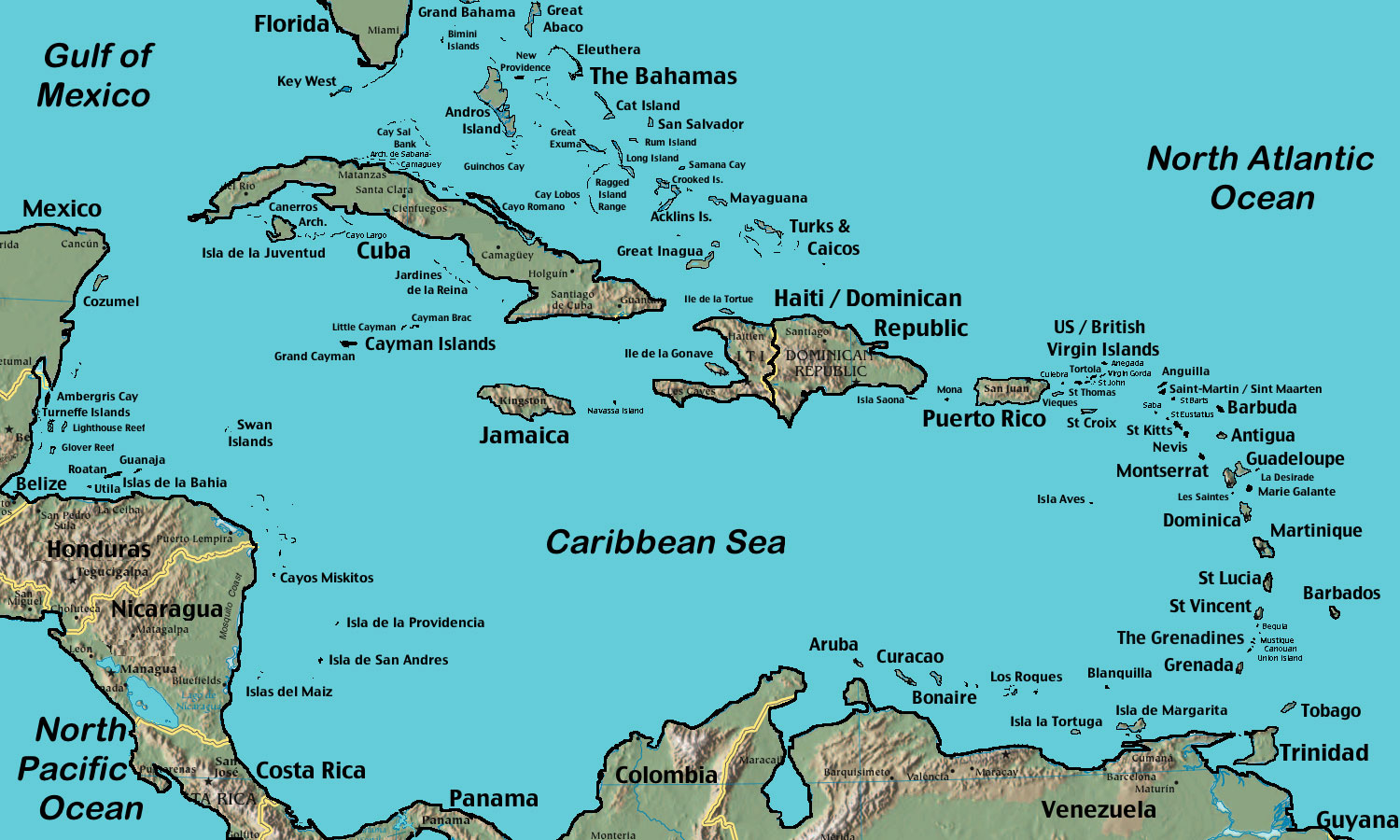
I work as the climate change adviser for the DFID Caribbean office. I am based in our regional office in Barbados as part of our Tackling risks to growth team. I have been working in the Caribbean for over eight years on issues like water resource management and now disaster risk reduction and climate change. I used to work in southern Africa, so my life journey means I have moved from a very water scarce region to places that have a rainy season for several months of the year!
Although I see beautiful blue aquamarine water and sandy beaches on my way to work – ahh the tough life you would say – the reality is that the islands here are facing extremely difficult challenges and decisions about coastal planning and future water supply when they look at the predicted impacts of increasing sea level rise, and what it means if it gets even hotter or we frequently lose crops because they are wiped out regularly by heavy wind or bad storms.
While reading a press article this week to mark International day for Disaster Risk Reduction, the Executive Director of the Caribbean Disaster Emergency Management Agency, Jeremy Collymore, pointed out that our region was the second most prone to hazards in the world. This reminded me of the staggering stats about losses suffered by the region since I have lived here. In 2004 damage in Grenada by Hurricane Ivan was estimated at 212% GDP. In 2005 Guyana lost 60% of GDP due to floods. And just last year four tropical storms one after the other in Haiti caused damages and losses of around 15% GDP. This kind of economic setback takes a really long time to recover from and climate change predictions say the situation will be made even worse. Talk about salt in a wound.
So then you understand the region's tough stance at the international negotiations - given that they are already struggling to cope with present day climate and what the predictions look like, they want no more than a 1.5 degree rise in global temperature – this is an issue of survival for all small island states and low lying coastal areas around the globe - where relocation for some is already an unavoidable future reality.
I get excited by my work in the region because there are some excellent home grown policy platforms to build on. It was really encouraging to see all heads of state endorse the Regional Framework for Achieving Development Resilient to Climate Change (PDF) in June this year and the 2007-2012 Comprehensive Disaster Management Strategy (PDF) that is much more results based. There are adaptation pilot projects now underway, global funds coming in to help scale up adaptation efforts and already quite a lot of progress has been made around the planning and capacity building stages for adaptation through work of the Caribbean Community Climate Change Centre. We now need a clear vision of what success will look like and accelerated action, but I do not underestimate the challenges like for example working effectively across over 20 states and the fact that we are now being hit very hard by the recession.
Some of the topics that I am curious about that come to mind to blog about are
- the excellent and widespread use of solar in Barbados homes - but I want to know why it hasn’t caught on in rest of region?
- the only Clean Development Mechanism project in the region – a wind farm in Jamaica. And the bottlenecks around this finance source
- the ambition to become a carbon neutral regional destination by 2015 (before Maldives who say they will achieve that by 2019)
- the latest on geothermal potential, energy efficiency improvements and low carbon development

- or my recent discovery of how brilliant the parrotfish are (see the picture). They say they are like a toothbrush for dental health - the magic ingredient to helping coral recover after being damaged, which is really important when the Caribbean has the largest proportion of corals in high extinction risk categories.
Wow, I was really nervous as this is my first ever blog post, but now it has me going…
This blog features as part of Blog Action Day and the Act on Copenhagen campaign

14 comments
Comment by Colin L Beadon posted on
Simone,
I'm concerned about our islands, and the whole Earth, when it comes to climate change. You could find , if you desire to vet me, some of what I've written in Barbados Free Press for the last couple years.
There is a great lip service to the desire that something should be done about climate change in our islands, and across much of the world. But who is prepared to give up their SUVs, or clamp down on their air travel, or, or or, ad infinitum. You don't see the stars in Barbados any more, for the harsh glare of brilliant electic light, out- shinning the mysterious splendor of the full moon.
Have you read the new book by James Lovelock ? The Revenge of Gaia ? Yes, yes, I'm one of those, an old one, with enough world- stretching experiences, including geothermal drilling in St Lucia.
Colin.
Comment by SAAW International posted on
In the run up to the Copenhagen climate change conference, it is vital the following information be disseminated to the public as well as to our political leaders.
A widely cited 2006 report by the United Nations Food and Agriculture Organization, Livestock's Long Shadow, estimates that 18 percent of annual worldwide greenhouse gas (GHG) emissions are attributable to livestock….however recent analysis by Goodland and Anhang co-authors of "Livestock and Climate Change" in the latest issue of World Watch magazine found that livestock and their byproducts actually account for at least 32.6 billion tons of carbon dioxide per year, or 51 percent of annual worldwide GHG emissions!
http://www.51percent.org
The main sources of GHGs from animal agriculture are: (1) Deforestation of the rainforests to grow feed for livestock. (2) Methane from manure waste. – Methane is 72 times more potent as a global warming gas than CO2 (3) Refrigeration and transport of meat around the world. (4) Raising, processing and slaughtering of the animal.
Meat production also uses a massive amount of water and other resources which would be better used to feed the world’s hungry and provide water to those in need.
Based on their research, Goodland and Anhang conclude that replacing livestock products with soy-based and other alternatives would be the best strategy for reversing climate change. They say "This approach would have far more rapid effects on GHG emissions and their atmospheric concentrations-and thus on the rate the climate is warming-than actions to replace fossil fuels with renewable energy."
The fact is that we are being informed of the dangerous path we are on by depending greatly on animal flesh for human consumption. We still have the opportunity to make the most effective steps in saving ourselves and this planet. By simply choosing a plant based diet we can reduce our carbon foot print by a huge amount.
We are gambling with our lives and with those of our future generations to come. It's madness to know we are fully aware of the possible consequences but yet are failing to act.
Promoting a plant based diet to the public is would be the most effective way to curb deforestation, we hope this will be adopted as a significant measure to save the rainforests and protect the delicate ecology.
Thank you for your consideration.
Comment by children denist posted on
There's a great lip service to the desire that something should be done about climate change in our islands, and across much of the world. But who is prepared to give up their SUVs, or clamp down on their air travel, or, or or, ad infinitum. You don't see the stars in Barbados any more, for the harsh glare of brilliant electic light, out- shinning the mysterious splendor of the full moon.
Comment by safa posted on
We produce more CO2 than ever and destroy forests faster than before. No wonder the nature is not working any more as it should.
Comment by Alexander posted on
Simone, I lived in Barbados for a while and I can't agree with you more. I came across this page and it really reminded me of the time I spent there.
Almsot every year devastating natural disasters occur to different parts of the region yet I find despite everything people never lost their smiles. It taught me a lot about dealing with adversity.
Added into that the millions of barrels of oil spilling into the sea not too far away and you just have hope that mankind can get it's act together and support this wonderful part of the planet.
Comment by Caleb posted on
I think that Barbados' relative affluence and development compared to its neighboring islands is the biggest reason rooftop solar panels have caught on so well. But they've had "sustainable energy projects" for several hundred years: bagasse - what's left over after you squeeze all the juice from the sugarcane - with its sometimes fragrant but usually awful smell! It's been consistently used as biofuel for more than 300 hundred years. So, the idea of non-fossil fuel energy sources, solar power or agricultural waste, is totally normal in Barbados.
Comment by April posted on
Caleb, I think that it is incredibly commendable that people of Barbados are used to the idea of non-fossil fuel energy sources. Barbados doesn't have an image of a global leader yet here it is actually making a difference. I aim to do my bit by being a vegetarian as I believe that so much CO2 comes from the over production/breeding of cattle just as was mentioned by SAAW international.
Will the whole world ever change? Maybe....but probably when it's too late!
Comment by Ray Wilson posted on
Well, it's true that we burn more fossil fuels and deforest than ever before. We certainly aren't too concerned about the nature at the moment. But what exactly has led to the situation it is today? In my opinion, the single most important power in the world is energy itself. If you think about it, only energy resources can give us great prosperity. And, when people see, the best opportunity is to use fossil fuels right now, they simply use them. They don't think much about the harm to the environment. We need to make a shift as soon as possible, before it all gets irreversible.
Comment by Cisco Chung posted on
Slowly, things are changing. For instance, in Australia, the government is pushing for solar panels on every home and although we're not all on solar panels yet, there is a growing % each day. It all seems like lip service, but we're getting there slowly.
We are more and more inclined to buy recycled paper every day. 10 years ago, you would be frowned upon to buy recycled paper.
Comment by warren percy posted on
I see the latest data shows the ice melt rate is increasing and that over the next thirty years we can expect in overall increase of five inches.... the people of the Caribbean are right in the firing line!!
Comment by Fabiola Kijowski posted on
We create much more CO2 than ever before and ruin forests quicker than prior to. No wonder the nature isn't operating any much more because it ought to.
Comment by james posted on
If you concentrate on it, only energy resources can give us great wealth. And, when folk see, the best opportunity is by using normal fuels at the moment, they employ them. They do not think much about the harm to the environment.
We want to make a shift asap, before it all gets irreversibl
Comment by Ron posted on
As your first blog post it's not a bad one at all! Quite the opposite. On the subject of fresh water I firmly believe that in the near future there will be civil wars over the supply of fresh water.
We hear 'climate change' bandied about all the time but are the majority aware that this will (and is) causing previously wet countries to become dry?
I'm thinking that, as cold as the recent winters in the UK, we are lucky in that we look to have a decent supply of fresh water for the foreseeable future.
We don't have major earthquakes, or natural disasters on the scale of other regions (Carribean for example) and I think a lot of us don't realise how lucky we are. Well, we have Dave Cameron for a PM so maybe not too lucky.
Ron
Comment by roseyrecl posted on
I think this is very useful for my Social Studies work.